BDA CHRONICLES · 2027 OFFSEASON | DRAFT / OWNERS MEETING / LEAGUE AFFAIRS
THE DRAFT WAS ONLY HALF THE DEAL
A three-team blockbuster rewrote the first round before it began. Then came 65 selections, a few remarkable slides, and a league that now has to make its camp rosters fit.
2027 post-Draft coverage · October 12 pre-cutdown rosters
The BDA held a draft. Then it had to figure out what it had done.
By the time the last name was called, 65 players had been selected, 26 available turns had been passed over because of roster limits. Ayo Dosunmu went to the Knicks in Round 12 with the final official selection, No. 96. The two owners had done what they came to do, although calling it a straightforward exercise in roster building would be generous.
The real explosion happened before the first pick. On October 8, a certified three-franchise trade moved two of last season's most promising young players, two veteran frontcourt anchors, a top first-round slot and another early pick. Then the October 9 Owners Meeting rewrote the rules of how the league would handle training camp, waivers and even its championship hardware. The actual draft followed on October 10, with Lakewood making the first live selection.
If the old BDA draft was a night of grabbing names, this one was a full offseason compressed into several days.
THE DEAL THAT MOVED THE ROOM
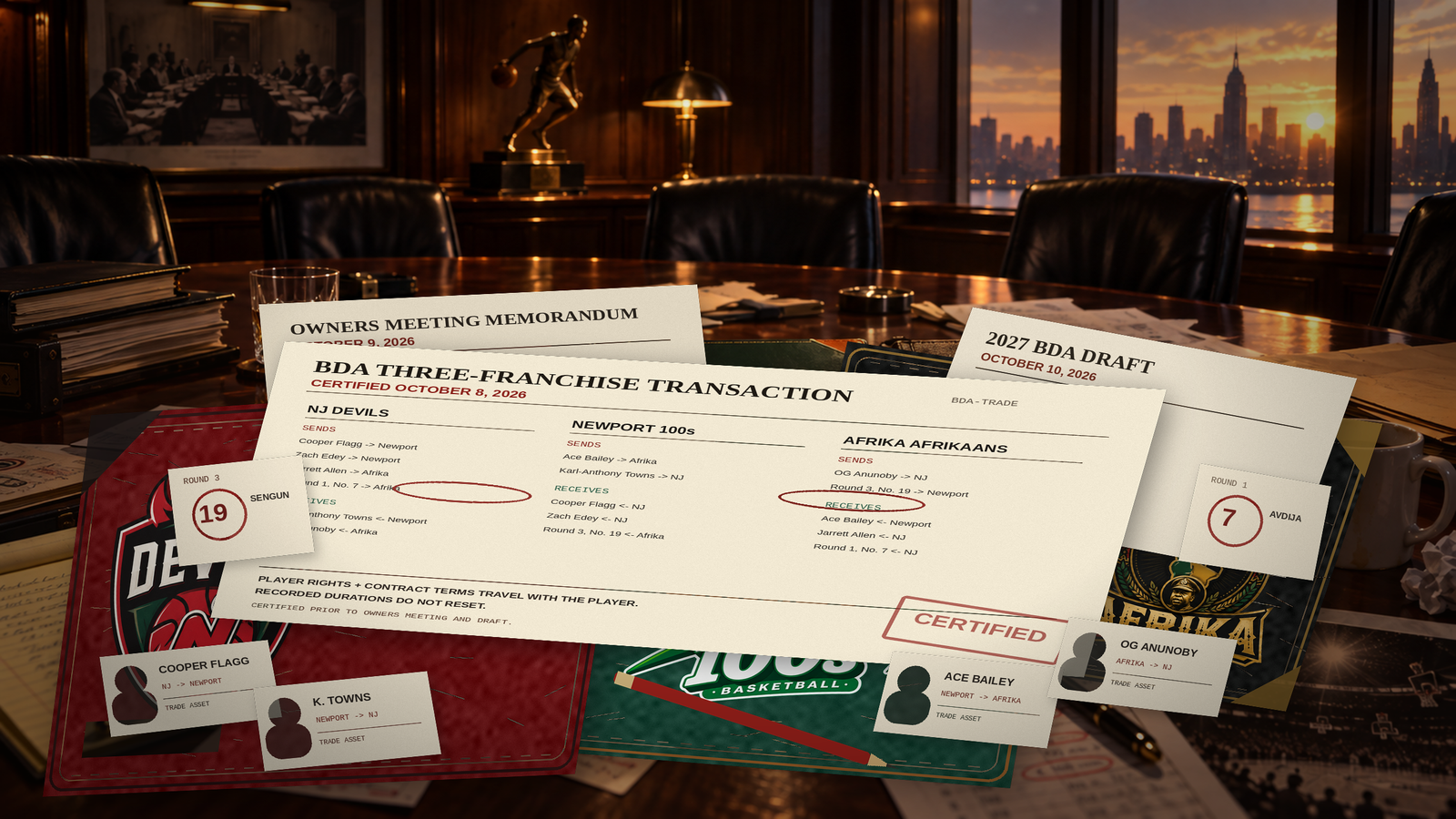
The trade register leaves no mystery about the participants: NJ Devils, Newport 100s and Afrika Afrikaans. The exchange was certified October 8, before the draft and before the October 9 meeting. It was not a spontaneous draft-night trade, and the record should not be romanticized into one.
Here is what changed hands.
Afrika Afrikaans
Afrika sent OG Anunoby to New Jersey and its Round 3, No. 19 selection to Newport. Afrika received Ace Bailey from Newport, Jarrett Allen from NJ and the Devils' Round 1, No. 7 selection.
Newport 100s
Newport gave up Bailey and Karl-Anthony Towns, receiving Cooper Flagg and Zach Edey from New Jersey plus the No. 19 pick from Afrika.
NJ Devils
New Jersey surrendered Flagg, Edey, Allen and the No. 7 pick, receiving Towns and Anunoby.
All the player rights and contract terms attached to those players traveled with them; the recorded durations did not reset.
That is not a minor exchange of spare parts. Newport, already champion, changed its future: Flagg and Edey join Kon Knueppel, VJ Edgecombe and the returning Rodman-Luka core. Afrika gained a young wing in Bailey, a legitimate center in Allen and a second first-round bite. NJ sacrificed young frontcourt control for a ready-made veteran pairing in Towns and Anunoby. The Devils were betting that a Finals team built around Brunson needed better immediate collaborators, not more developing prospects.
The draft confirmed those priorities. Afrika used its original No. 3 slot to bring Anthony Davis back and the acquired No. 7 on Deni Avdija. Newport converted the extra No. 19 into Alperen Sengun and used its own No. 24 on Cameron Boozer. NJ did not pick until Round 2, when it chose Mikal Bridges at No. 10. Three teams gave up different things and came away with three different identities.
There is also an important bit of governance chronology here. The multi-team exchange predates the subsequent Owners Meeting rule prohibiting same-owner franchise-to-franchise trades. The transaction register marks this earlier trade certified. The meeting's newly adopted restrictions should not be casually projected backward onto a move that was already completed.
THE FIRST ROUND DID NOT READ THE MOCKS
Lakewood owned the first live selection because the Knicks' opening position had already been consumed by Carmelo Anthony's retention. The Lightning took Kevin Durant at No. 2. That is an unmistakable choice of ceiling over tidy positional balance. Lakewood already had Giannis Antetokounmpo and Jayson Tatum; apparently another premier forward seemed preferable to letting Durant become somebody else's problem.
Afrika reclaimed Anthony Davis at No. 3. Bronx took memorial-eligible Bob Pettit at No. 4, bringing the 96-rated All-Decade legend into a backcourt-heavy team that had just upset Lakewood in the previous playoffs. Atlantic City went for Amar'e Stoudemire at No. 6, pairing a ferocious scoring big with Victor Wembanyama. Afrika used New Jersey's traded No. 7 selection on Avdija. Three nominal first-round positions were already spoken for through retentions, so the first round contained fewer actual picks than its eight slots suggested.
By the time Newport opened Round 2 with Jaden McDaniels at No. 9, the story was clear. There were no automatic rules about taking the highest current NBA name or filling the most glaring positional hole. Pettit, Stoudemire and later Charles Oakley were not ornaments in this pool. They were real choices with very real consequences for opponents.
SOME TEAMS DRAFTED AN IDEA. OTHERS DRAFTED AN ENTIRE TEAM.
The Knicks could not start until Round 3, and still finished with a league-high ten actual selections. Trey Murphy III at No. 17 was their first, followed by Caleb Wilson, Josh Giddey, Desmond Bane, Lu Dort, Norman Powell, Naz Reid, J.R. Smith, Trae Young and finally Dosunmu. There is a coherent outline beneath that volume: shooters and perimeter defenders around Melo, Jokic and Cade. Whether Trae should have been available until Round 11 is one of those questions a draft room should be arguing about well into the next season.
Lakewood selected Durant, Oakley, De'Aaron Fox, Devin Vassell, Cason Wallace, Jrue Holiday, Tarris Reed Jr. and Bol Bol. The headline is Durant, but Fox and Holiday may ultimately be just as important to correcting the offense and defending the point of attack. The Lightning did not merely add another star; they rebuilt the perimeter while maintaining enough size to make opposing lineups miserable.
Bronx took Pettit, Franz Wagner, Lauri Markkanen, Ja Morant, Alex Sarr, the current Paul George, Isaiah Hartenstein and Darius Acuff Jr. It is a strange, enormous, talented collection. The Gauchos did not get Kevin Durant back. They may have replaced him with several different solutions and an entirely new problem: finding enough minutes for everyone.
Atlantic City added Stoudemire and Bam Adebayo early, then Darryn Peterson, Michael Porter Jr., Ben Simmons, Ryan Kalkbrenner, Yaxel Lendeborg and CJ McCollum. The front-office intent is visible: Wembanyama finally gets genuine help inside, while the guard and wing depth provides options that were missing during the Aces' 6-10 season.
Newark made only six selections, fewest in the league. Pascal Siakam, Tyler Herro, Dillon Brooks, Domantas Sabonis, Alex Caruso and Alex Karaban tell a distinct story around Dwight Howard: more size, more secondary scoring, more defense, and perhaps still not enough shooting. NJ made nine selections and leaned hard into familiar New York basketball names with Bridges, Josh Hart, Kristaps Porzingis, Mitchell Robinson and Donte DiVincenzo among its additions. Newport took eight and quietly built a wildly different supporting cast around a champion, including Sengun, Boozer, Zion Williamson and Jamal Murray.
THE RISING STARS WERE NOT AFTERTHOUGHTS
The most famous young names did not all carry the same legal status merely because they were young. The official post-draft roster record confirms new Rising Star protection for Cameron Boozer, AJ Dybantsa, Darryn Peterson, Caleb Wilson, Darius Acuff Jr., Keaton Wagler, Yaxel Lendeborg, Tarris Reed Jr., Alex Karaban and Braden Smith. Their teams received a developmental runway instead of just a one-season trial.
Several of those choices were meaningful competitive decisions. Newport took Boozer at No. 24 after securing Sengun. New Jersey selected Dybantsa at No. 26, a potential future offensive centerpiece amid a veteran-heavy reconstruction. Atlanta City's Peterson pick came at No. 27; the Aces are not short on immediate talent, so his growth is the longer bet. New York used its fourth-round position on Caleb Wilson while keeping its title aspirations attached to Anthony and Jokic.
That distinction matters because the new homegrown rules protect long-term development without transforming every ordinary first-year BDA participant into a Rising Star.
THE OWNERS MEETING MADE THE NEXT PHASE COUNT
The October 9 meeting was more than procedural cleanup. A new 20-player physical Training Camp limit allows teams to carry more than the 15 they must eventually take into the season. Opening Day requires 14 active players and one reserve. Rights-held players are separately accounted for. The waiver clock starts with the first valid claim, and a successful claiming team moves to the back of the queue. The owners also formalized transaction review and separated the franchise championship trophy from the human controller's championship belt.
That last distinction settles the strange 2026 Finals history. Newport beat NJ four games to one and keeps the franchise championship. Oliver, who controlled the winning Newport team in that Finals, receives the inaugural human championship belt. Dennis Rodman remains Finals MVP. The game results did not change; the league finally gave the human and the franchise separate lines in the history book.
These are the clubs as assembled after the draft, before the 15-player Opening Day cutdown. Cuts and claims deserve their own follow-up once completed.
DRAFT BY THE NUMBERS
| Draft fact | Result |
|---|---|
| Draft | Complete |
| Recorded opportunities | 91 |
| Actual selections | 65 |
| Intentional roster-cap skips | 26 |
| Duplicate official selections | 0 |
| Last pick | Ayo Dosunmu, NY Knicks, Round 12, overall No. 96 |
| Most selections | NY Knicks, 10 |
| Fewest selections | Newark Riots, 6 |
| NJ Devils | 9 selections |
| Lakewood, Afrika, Bronx, Atlantic City and Newport | 8 each |
| New Rising Star draftees | 10 |
| Special/legend selections | Bob Pettit, Amar'e Stoudemire, Charles Oakley and J.R. Smith |
| Pre-cutdown physical roster total | 133 across eight franchises |
| Rights held separately in the October 12 roster report | 3, including Danny Wolf, Dalton Knecht and Zaccharie Risacher |
THE PART AFTER THE APPLAUSE
The draft produced some wonderful possibilities and a few rosters that look as though the owner intends to play seven men at the same time. That is fine in October, when training camp is designed to turn abundance into a rotation. It will be less fine when the deadline arrives.
Lakewood has a decision about how Durant fits beside Giannis and Tatum. Newport has a championship to defend while finding roles for Flagg, Edey and a new crowd of forwards. New Jersey has to determine whether assembling a familiar NBA title-team skeleton gives Brunson more help or simply more nostalgia. Bronx has the Pettit experiment. Afrika has an improved frontcourt, and Atlantic City has a much larger one.
There will be arguments. Some selections will age badly. Some discarded players will become the best waiver bargains in the league.
That is what the BDA has signed up for.
The draft did more than distribute talent. It created the choices that will define the season.