BDA CHRONICLES · 2027 OFFSEASON | FRONT OFFICE / DRAFT GRADES / TRAINING CAMP
EIGHT ROSTERS. EIGHT PLANS. A FEW HAVE TOO MANY CENTERS.
The draft grades are in, and the interesting question isn't who collected the most talent. It's whose talent is going to make sense when the ball goes up.
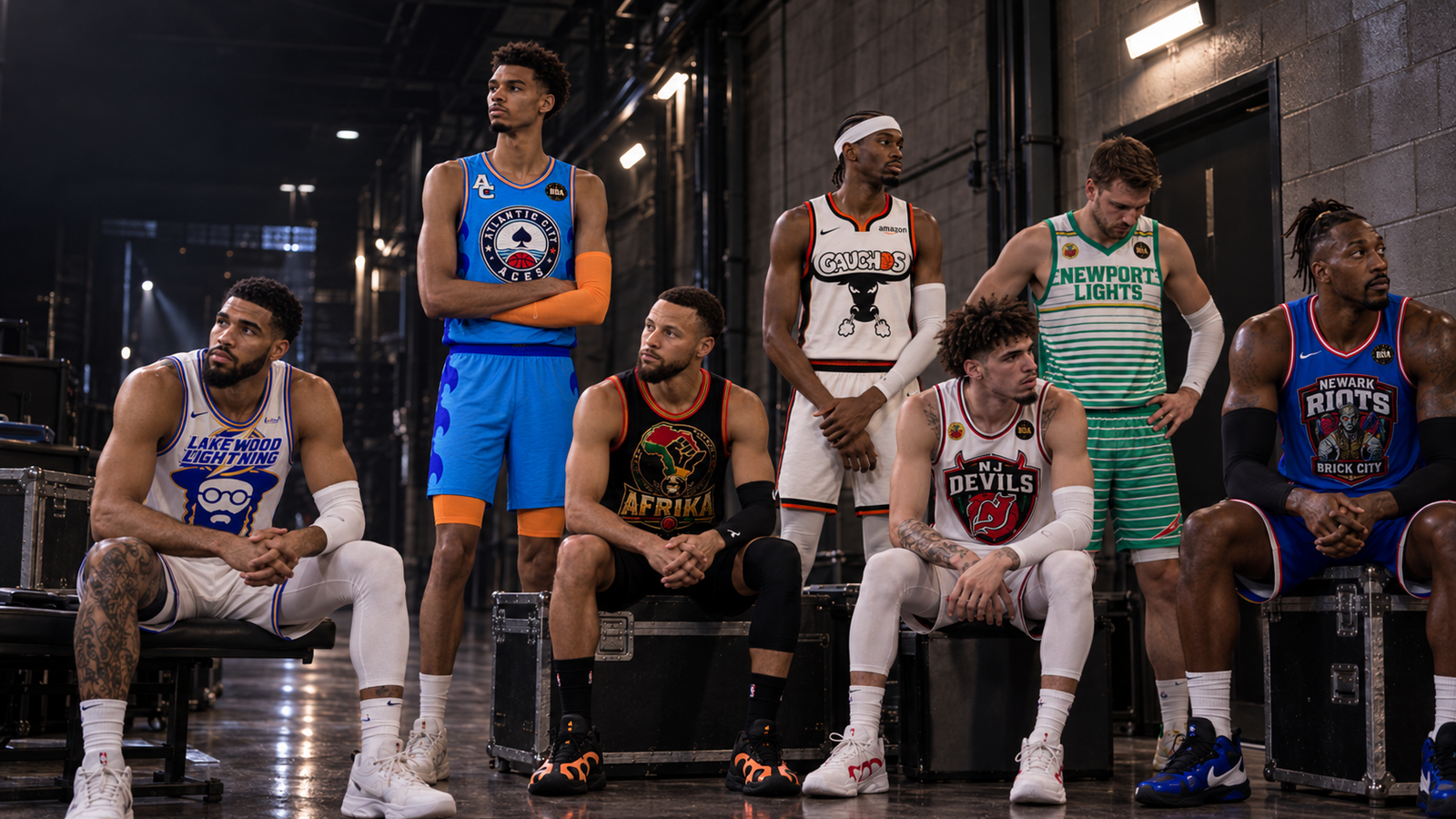
2027 post-Draft coverage · October 12 pre-cutdown rosters
There is nothing particularly hard about drafting talented basketball players in a league that allows Bob Pettit, Kevin Durant, Giannis Antetokounmpo and Victor Wembanyama to occupy the same competitive universe. The hard part is taking those players into a game and discovering whether they can stand in the right places, defend the right people and survive the last three minutes.
The 2027 BDA Draft handed every franchise new possibilities. It also handed most of them a choice they will not enjoy making. The October 12 certified pre-cutdown roster lists show 16 to 18 physical players per club, plus three documented rights-only players. Opening Day allows 15, including one reserve. None of these oversized camp lists should be mistaken for final rosters.
These grades judge the draft and offseason construction, not the standings we expect to see in February, and not the number of famous people who answered the roll call.
LAKEWOOD LIGHTNING
What they did
With the first live selection, Lakewood took Kevin Durant. Then it drafted Charles Oakley, De'Aaron Fox, Devin Vassell, Cason Wallace, Jrue Holiday, Tarris Reed Jr. and Bol Bol. There are 18 players in camp and Danny Wolf's rights are held separately.
What the roster says
Ron remembers last season's 11-5 regular season, but he also remembers the first-round collapse against Bronx when a five-out lineup sent the league's best defense searching for the wrong matchup. Lakewood did not respond by merely adding another shot-blocker. Fox, Wallace and Holiday supply guard pressure and ballhandling. Vassell adds perimeter shooting. Durant gives Tatum and Giannis an almost absurd second or third option, depending on who has the ball.
What I like
The guard upgrades are better than the headline. Fox can attack without requiring Tatum to run point; Holiday takes hard defensive assignments; Wallace lets Lakewood pressure the ball. The roster can play fast, slow, big or switch-heavy. Oakley is an enormous-value second-round addition if the All-Time version plays as advertised.
What worries me
Durant, Giannis, Tatum, Paolo Banchero, Jimmy Butler and Aaron Gordon cannot all occupy the same advantageous spots. Oakley and Gobert narrow spacing further in certain combinations. Giannis was the 2026 ace with 10.7 points per game, and handing him a superstar teammate is not automatically the same as improving his best actions. Three camp cuts are due, and the team may have to reject a useful player simply because the rotation is too crowded.
The bet
Great perimeter additions will fix last year's schematic failure, while the coaching choices keep the massive frontcourt from becoming a queue.
Best move
Fox at No. 18, the least glamorous but perhaps most corrective high-end addition.
Biggest question
Can Lakewood resist playing every star because it owns him?
NY KNICKS
What they did
After Carmelo Anthony and Nikola Jokic consumed their first two rounds, the Knicks selected Trey Murphy III, Caleb Wilson, Josh Giddey, Desmond Bane, Lu Dort, Norman Powell, Naz Reid, J.R. Smith, Trae Young and Ayo Dosunmu. Ten players, the largest haul in the league, rebuilt the supporting cast around Melo, Jokic and Cade Cunningham. Sixteen physical players now have to become fifteen.
What the roster says
Oliver did not forget that his 11-5 Knicks lost four straight to Newark after going up 2-0. He kept the franchise's ace, Melo, and the system's offensive center, Jokic, but replaced nearly everything else. The new guard and wing mix has real logic. Bane and Murphy stretch defenses, Dort can guard the matchup nobody else wants, and Giddey supplies passing size. Naz Reid brings a mobile scoring alternative behind the bigs.
What I like
Value and role differentiation. Finding Trae Young in Round 11 is almost embarrassing for the rest of the room. But the sleeper for steal of the draft is J.R. Smith, taken at No. 80 in Round 10. The approved version is the 79-rated shooting guard/small forward from the 2015-16 Cleveland Cavaliers, a championship-era shooter who would not need to dominate the ball beside Jokic, Melo, Cade and Trae. There is no guarantee his BDA production will match the reputation, but that is exactly why he is an interesting late-round investment rather than a presumed star. Bane and Murphy stretch defenses, Dort can guard the matchup nobody else wants, and Giddey supplies passing size. A workable Knicks lineup has Trae creating, Bane and Murphy spacing, Melo attacking and Jokic orchestrating. Another can use Cade, Dort and more size. Caleb Wilson gives New York developmental value amid the veterans.
What worries me
Trae can make the defense a target. Bane, Cade, Giddey and Melo all need touches to reach their best selves, while the Knicks' first-round cost may be felt years later. The temptation is to play the highest-rated five instead of a defensible five. The cut decision should be about redundancy, not who looks least famous.
The bet
Retain the elite offensive spine, replace the balance that cost the club the playoffs and outscore the rest of the league. The neighborhood subplot belongs to J.R. Smith. Smith played basketball at Lakewood High School and identified Lakewood, New Jersey as the town where he grew up, making him an obvious sentimental fit for the Lakewood Lightning and a name the BDA rumor mill expected to land there. The actual draft could hardly have scripted a sharper snub: Ron's Lakewood selected Bol Bol at No. 79 in Round 10, and Oliver's Knicks took Smith with the very next selection, No. 80, just 31 seconds later. Lakewood had the first chance and passed. If Smith becomes the off-ball shooter New York hopes to have found, the potential steal of the draft also becomes a local rivalry story.
Best overall value move
Bane at No. 48.
Best late-round gamble
Smith at No. 80.
Biggest question
Has Oliver found a defense that can survive his own offense?
NJ DEVILS
What they did
New Jersey moved Cooper Flagg, Zach Edey, Jarrett Allen and a first-round selection in the three-team pre-draft trade, receiving Karl-Anthony Towns and OG Anunoby. It then drafted Mikal Bridges, Josh Hart, AJ Dybantsa, Kristaps Porzingis, Mitchell Robinson, Jose Alvarado, Donte DiVincenzo, Braden Smith and Lonzo Ball. Seventeen physical players remain in the post-draft camp roster.
The old BDA championship photograph is the wrong photograph. The certified 2026 BDA Knicks were 11-5, but Newark eliminated them 4-2 in the first round. Newport, not New York, won that BDA title, defeating these very Devils 4-1 in the Finals. The BDA Legacy Archive credits the Knicks with two earlier championships, both in NBA 2K20, and none of the confirmed players on those two championship rosters appears on this NJ camp list. Of all 15 players on the 2026 BDA Knicks' final roster, only Kristaps Porzingis is now on the Devils. He arrived in the 2027 Draft, Round 5, No. 39. He was a former BDA Knick, not a member of a 2026 BDA Knicks championship team that never existed. That is the actual BDA lineage, and a front office should not get to borrow a nonexistent trophy for its roster narrative.
What the roster says
There is nevertheless a real and unusually large New York reunion, but it comes from a different league. SEVEN members of the REAL NBA's 2026 champion Knicks are on NJ's certified pre-cut BDA camp roster: Jalen Brunson, Karl-Anthony Towns, OG Anunoby, Mikal Bridges, Josh Hart, Mitchell Robinson and Jose Alvarado. Brunson was already a BDA Devil and carried NJ to last season's Finals. Towns came from Newport and Anunoby from Afrika in the October 8 three-team trade; NJ drafted Bridges in Round 2, Hart in Round 3, Robinson in Round 6 and Alvarado in Round 7 at No. 55. Donte DiVincenzo, taken in Round 8, is another former real NBA Knick, but not a member of that 2026 NBA title roster. Brunson creates, Towns screens and stretches the court, OG and Bridges defend wings, Hart rebounds and connects possessions, Robinson protects the paint, and Alvarado supplies ball pressure and bench organization. Most important, Alvarado also arrives with direct BDA championship-run credibility: playing for eventual champion Newport in 2026, he was the first-round Series MVP against Afrika. This isn't just an NBA reunion; one of the new Devils helped defeat Afrika on the way to Newport's BDA trophy. AJ Dybantsa is the counterweight: a genuine future-facing wing amid the veteran reunions.
What I like
NJ addressed a real deficit rather than merely recreating a photograph. Last year's Devils reached the Finals with Brunson and a procession of centers but too few trusted two-way wings. Anunoby and Bridges let the club defend the perimeter without asking Brunson to do everything; Hart supplies the possession-winning work New Jersey lacked, while Towns opens shooting space that Edey and Zubac could not. Alvarado gives the guards a pest who can manufacture stops and run possessions without challenging Brunson's offensive authority. He earned Newport's 2026 first-round Series MVP against Afrika in a seven-game survival test: 10 points, 6 assists and 3 steals in Game 4, then 7 points, 6 assists, 2 steals and no turnovers in the deciding Game 7. That production was a meaningful part of Newport's eventual title path, not a ceremonial ring. The real NBA Knicks' history gives seven of these players familiarity with the same winning organization, but the important test is whether those roles translate into a better BDA five.
What worries me
The bill is enormous. Flagg and Edey were controlled young players, Allen had two years of contract control, and NJ surrendered its No. 7 first-round slot in the trade. The camp still includes Zubac, Turner, Porzingis and Robinson in addition to Towns, so this grand renovation could still leave too many centers, which would be an impressive failure of architectural planning. Seventeen physical players require two cuts, and the most famous five need not be the best defensive five.
The bet
Build a credible BDA contender around Brunson's proven postseason scoring by importing a seven-man real NBA championship contingent, plus Alvarado's independently proven BDA playoff defense and playmaking. That is a basketball argument, not proof of a BDA Knicks championship reunion.
Best move
Bridges, the defensive wing NJ plainly needed.
Best under-the-radar addition
Alvarado at No. 55.
Biggest question
Can this team import useful chemistry without importing nostalgia as a substitute for lineup judgment?
NEWPORT 100S
What they did
The defending franchise champion made the loudest youth trade in the league, turning Ace Bailey and Karl-Anthony Towns into Cooper Flagg, Zach Edey and a newly acquired Round 3 selection. The 100s used that extra pick on Alperen Sengun, then drafted Jaden McDaniels, Cameron Boozer, Zion Williamson, Grayson Allen, Jamal Murray, Dereck Lively II and Luke Kennard. Eighteen physical players now crowd the camp.
The Duke link survives a player-by-player check, but the number should be labeled correctly. Seven players on Newport's October 12 certified physical camp roster actually played for Duke: Cooper Flagg, Kon Knueppel, Cameron Boozer, Zion Williamson, Dereck Lively II, Grayson Allen and Luke Kennard. All seven are physically rostered in this pre-cut snapshot; none is merely rights-held. Flagg arrived in the October 8 trade, Knueppel was retained, and Boozer, Zion, Lively, Allen and Kennard were 2027 selections. Duke's own historical basketball rosters confirm their affiliations. That is a remarkable concentration, not evidence that they were all college teammates or that Duke basketball is a ready-made BDA offensive system.
What the roster says
The stronger personnel story is deliberate youth accumulation around a championship backbone. Five Newport players carry Rising Star control in the post-draft roster: Flagg, Knueppel, Cameron Boozer, VJ Edgecombe and Zach Edey. Flagg and Edey's rights arrived in the trade, so those two should not be mislabeled Newport's original homegrown draft discoveries. Knueppel is already a proven BDA scorer after averaging 15.2 a game in the title season. Luka remains the offensive organizer, and Rodman remains the Finals-MVP defensive conscience. The Duke ties are a striking thread through this roster, but Edgecombe came from Baylor, Brandon Miller from Alabama and the now-traded Ace Bailey from Rutgers. Newport's actual bet is on athletic length, shooting and a younger succession plan, not a college alumni reunion for its own sake.
What I like
Newport did not freeze the title team in glass. McDaniels gives Luka a legitimate perimeter defender, Jamal Murray brings a second creator, and Flagg and Boozer supply very different kinds of long-run upside. Sengun offers half-court passing from the front line. The seven Duke alumni are not interchangeable: Kennard is a shooting specialist, Lively a rim-running big, Allen an experienced guard, Zion a pressure-at-the-rim forward, and Flagg/Knueppel/Boozer the higher-upside young group. Those are roles worth evaluating, not just a college logo worth collecting.
What worries me
This is a land rush for frontcourt minutes. Rodman, Edey, Kessler, Mobley, Sengun, Lively, Zion, Boozer and Flagg cannot all get their preferred usage or position. Three players must go before Opening Day, and the departures could be meaningful. Newport risks changing too much of the identity that beat NJ 4-1 in the Finals.
The bet
Carry the Rodman-Luka winning identity forward while acquiring enough younger, controllable talent to keep Newport relevant when its veterans decline.
Best move
the October 8 Flagg/Edey trade and the acquired No. 19 selection that became Sengun, although the cost included Bailey and Towns.
Biggest question
Can the 100s keep the developmental upside after a three-player cutdown without turning the rotation into a traffic jam?
BRONX GAUCHOS
What they did
Bronx selected Bob Pettit at No. 4, then Franz Wagner, Lauri Markkanen, Ja Morant, Alex Sarr, current-version Paul George, Isaiah Hartenstein and Darius Acuff Jr. The new group joins SGA, Maxey, Donovan Mitchell, Chet Holmgren, Jaren Jackson Jr. and Kel'el Ware. Sixteen physical players mean one eventual cut.
What the roster says
The Gauchos learned from their 5-11 regular season and their stunning first-round upset of Lakewood. Five-out spacing changed that series. Pettit adds a 96-rated historical scorer and rebounder, Wagner can work across the wing and forward spots, and Markkanen is there to pull defenders away from the basket. The team also kept its exceptional defensive spine in Chet and Jackson.
What I like
The best-value swing in the draft is Pettit, especially after Durant left. SGA remains the ace; Maxey can serve as primary facilitator; Wagner is the kind of forward who makes the guards' decisions easier. Acuff gives a long-view guard option.
What worries me
Ja Morant is a difficult fit with SGA, Maxey and Mitchell if there are not enough spot-up possessions. Hartenstein and Sarr arrive behind a frontcourt that already contains Chet, JJJ and Ware. Pettit solves many talent questions but does not magically solve lineup arithmetic. There is no reason for a team that already has four ball creators to become even more stationary.
The bet
Turn the spacing scheme that beat Lakewood into a full-time identity, while Pettit raises the ceiling.
Best move
Pettit, plainly.
Biggest question
Can Bronx play the elegant five-out version of itself without four guards fighting over the steering wheel?
ATLANTIC CITY ACES
What they did
The Aces retained Wembanyama, Anthony Edwards, Kawhi Leonard, Scottie Barnes and Tyrese Haliburton, then selected Amar'e Stoudemire, Bam Adebayo, Darryn Peterson, Michael Porter Jr., Ben Simmons, Ryan Kalkbrenner, Yaxel Lendeborg and CJ McCollum. They carry sixteen physical players in the post-draft camp roster.
What the roster says
Atlantic City took the hint from its 6-10 regular season and NJ's four-game playoff sweep. Wembanyama cannot be the entire frontcourt while also leading scoring and protecting every defensive breakdown. Stoudemire provides force at the rim, Bam adds mobility and defensive communication, and Porter adds shooting length. The Peterson selection provides genuine developmental intrigue.
What I like
The first two picks are excellent. Amar'e adds the scoring big the offense lacked; Bam is the type of defender who lets Wemby move around rather than living as the last repairman on the floor. Haliburton should be able to connect all of them. A healthy Kawhi and Barnes pairing gives the Aces perimeter options.
What worries me
Ben Simmons adds yet another uncertain spacing fit. CJ McCollum and Keyonte George join an already crowded guard hierarchy behind Haliburton and Edwards. The Aces have never had a shortage of names. Their problem has been getting consistent lineups that know which job belongs to whom. Another collection of talented strangers will not fix a six-win season.
The bet
Give the best big man in the league a competent supporting frontcourt and hope the rest of the roster finally accepts its roles.
Best move
Bam at No. 11.
Biggest question
Are the Aces prepared to subordinate good individual players to a good team structure?
AFRIKA AFRIKAANS
What they did
Afrika used the traded NJ first-rounder on Deni Avdija after taking Anthony Davis at No. 3. Joel Embiid followed in Round 4, with Nickeil Alexander-Walker, Onyeka Okongwu, Bobby Portis, Damian Lillard and Keaton Wagler later. The pre-draft exchange also brought Ace Bailey and Jarrett Allen while OG Anunoby left for New Jersey. Sixteen physical players are listed.
What the roster says
Curry is still the ace and Devin Booker remains the scoring partner. But after Moses Malone retired and last season's big rotation unraveled, Afrika drafted as though it had sworn never again to lose a rebound. Davis, Embiid, Allen, Okongwu and Portis represent enormous interior recovery. Avdija is important because he does the less flashy wing work that OG's departure otherwise removed.
What I like
The draft restored a genuine competitive floor. Davis and Embiid are quality, not merely bulk. Jarrett Allen and Okongwu protect against bad matchups and injury. Deni gives Curry and Booker a ball-moving forward. Wagler adds the kind of long-term guard development that a veteran-centric roster needs.
What worries me
This is an overcorrection. Five substantial bigs will divide too few possessions and minutes. Lillard adds another small creation option behind Curry, Booker and Derrick White, but his individual usefulness is less certain if the defense cannot switch around him. The lost OG perimeter defense is real.
The bet
Size and talent will rescue a 6-10 team that was still able to push Newport to seven playoff games.
Best move
reclaiming Davis while also securing the traded No. 7 choice.
Biggest question
Which of the interior players actually complements Curry, rather than merely occupying a roster slot?
NEWARK RIOTS
What they did
Newark used six selections on Pascal Siakam, Tyler Herro, Dillon Brooks, Domantas Sabonis, Alex Caruso and Alex Karaban. That class joins Dwight Howard, Jaylen Brown, Kyrie Irving, Micheal Ray Richardson and a productive young forward group. Sixteen physical players and two off-roster rights holdings, Dalton Knecht and Zaccharie Risacher, appear in the October 12 roster report.
What the roster says
The Riots intend to play through Howard, a logical choice after his 17.1-point, 8.7-rebound season. Herro offers scoring, Brooks and Caruso add perimeter toughness, and Karaban is a young shooting-forward bet. There is merit there. The team's four straight wins over New York in the last playoffs did not come from being glamorous.
What I like
Caruso fits almost any winning lineup and can survive without the ball. Brooks supplies a difficult wing defender. Karaban brings a real developmental shooting-forward path. Herro would be especially useful if his offense rebounds, but the evidence is not yet persuasive: he averaged only 2.9 points for the 2026 BDA Knicks and hit 25 percent of his threes. Treating him as an automatic cure for Newark's spacing would be buying reputation instead of last season's film.
What worries me
Siakam and Sabonis are individually useful, but the 2026 BDA numbers did not make them obvious offensive saviors. Siakam averaged 2.5 points for Afrika; Sabonis averaged 2.0 for Bronx. Both prefer to do useful work near the paint, where Howard already operates. The team also has Jalen Johnson, Matas Buzelis and Derik Queen. Newark might have drafted additional furniture for a room whose problem was insufficient floor space. The 2026 minus-102 differential deserves more respect than the celebrity list.
The bet
Add enough quality around Howard that the next Knicks upset becomes routine rather than miraculous.
Best move
Herro, because reliable shooting was a more urgent need than another big.
Biggest question
How many non-shooting frontcourt minutes can one offense survive?
DRAFT CLASS RANKINGS
- Lakewood Lightning — A-. Best combination of immediate guard correction and elite upside, though the cuts and lineup hierarchy will hurt.
- NY Knicks — A-. Ten value selections and a clear rebuild around Melo/Jokic/Cade; Bane at No. 48 and hometown-Lakewood near-miss J.R. Smith at No. 80 provide two different kinds of draft value. The Trae defensive problem remains.
- NJ Devils — B+. Better positional architecture, seven members of the real NBA's 2026 Knicks champions and proven BDA playoff value from former Newport guard Jose Alvarado. None of that creates a fictional 2026 BDA Knicks championship. Expensive young assets went the other way.
- Newport 100s — B+. Terrific long-term upside, seven verified Duke alumni and five Rising Stars in camp, but a painful cutdown and serious frontcourt congestion.
- Bronx Gauchos — B+. Pettit is a home run. The rest of the roster still needs an adult to distribute roles.
- Atlantic City Aces — B. Great early bigs, but not enough evidence that the organization has stopped collecting overlapping talent.
- Afrika Afrikaans — B-. Far better interior talent and a sensible Davis return, but the center glut threatens the perimeter.
- Newark Riots — C+. Several individually useful additions without enough correction of the spacing problem around Howard.
These are construction rankings, not a preseason prediction. A team with a more balanced draft can still lose to a team with a single dominant matchup that nobody can solve. The more important judgment is what the rosters will look like after their owners make the cuts. Draft-night grades can be flattering. Playing five-on-five is less forgiving.