
BDA2K26 PLAYOFFS | LEAGUE NEWS
THE BRACKET BROKE. NOW OLIVER GETS THE CALL.
Bronx eliminated top-seeded Lakewood in Game 7, leaving three Ron-owned teams and one Oliver-owned team in the semifinals. BDA law cannot produce two ordinary Ron-vs-Oliver series, the archive says this has happened before, and defending champion Oliver now holds the league’s commissioner super-vote by established custom.
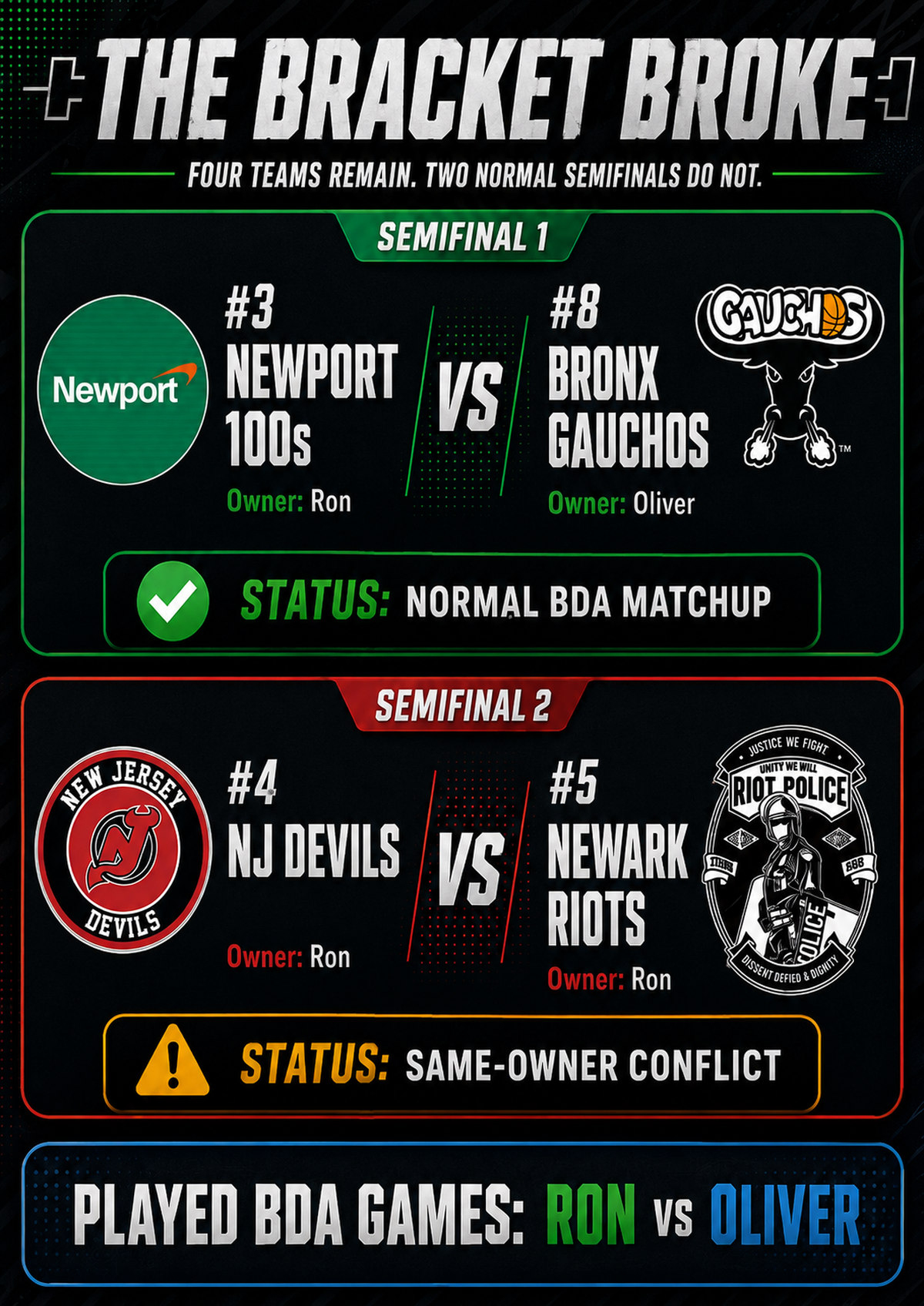
2026 semifinals: Newport 100s, New Jersey Devils, Newark Riots and Bronx Gauchos remain. No semifinal format has been selected.
Bronx spent seven games trying to become the first road team to win the Lakewood series. When the Gauchos finally did it in Game 7, they accomplished something larger than eliminating the No. 1 seed.
They broke the bracket.
The BDA’s final four now contains three Ron-owned franchises and one Oliver-owned franchise: Newport, New Jersey, Newark and the Bronx. Under a normal reseed, the highest remaining seed, Newport, would face the lowest remaining seed, Bronx. That part works exactly as intended. Ron vs Oliver. A conventional playoff series.
The other semifinal does not.
It would be the New Jersey Devils against the Newark Riots. Both belong to Ron. The approved BDA rulebook says official league games are supposed to be Ron vs Oliver and specifically bars Ron-vs-Ron or Oliver-vs-Oliver scheduled games unless the league creates a special exception.
For the first time in this postseason, winning has created a problem the standings cannot solve.
That problem is not merely logistical. It forces the BDA to answer a question that has been sitting underneath its modern structure for years: what, exactly, is the championship designed to reward?
Is the champion the best franchise? Is it the best owner? Or is the ultimate purpose of the postseason to guarantee a final controller-vs-controller test between Ron and Oliver?
Those ideas usually point in the same direction. In 2026, they no longer do.
THE FIELD THAT CREATED THE PROBLEM
The surviving teams entered the playoffs at very different points in the standings.
Newport is the No. 3 seed. The Devils are No. 4. Newark is No. 5. Bronx entered as the No. 8 seed and just eliminated No. 1 Lakewood in seven games.
If the bracket is treated as a franchise competition, all four teams have earned exactly the same thing: another series. No surviving team has lost the right to advance merely because its owner also controls another survivor.
If the postseason is treated primarily as an owner competition, the picture looks different. Ron has three remaining routes to the championship while Oliver has one. That creates pressure to collapse the three Ron teams into some type of internal qualifier and guarantee Bronx an Oliver-side place in the Finals.
The trouble with that solution is obvious. It would give the No. 8 seed a direct path to the championship round after one playoff series while forcing three teams that already won their quarterfinals to eliminate one another in an extra structure that did not exist when the playoffs began.
There is no painless answer.
But there is precedent.
THE ARCHIVE HAS SEEN THIS BEFORE
A review of the BDA Legacy Archive found two explicit same-owner semifinal cases from NBA 2K23.
In NBA 2K23 Season 2, Newark and Lakewood reached the semifinals. Both were Ron teams. The archive marks that series as SIMULATED. Newark advanced from the simulation, the rest of the bracket continued normally, and the Riots then played Oliver’s Gauchos in a conventional Finals.
One season later, the same problem appeared on Oliver’s side. The Knicks and Gauchos reached a semifinal against one another. The archive again marks the series as SIMULATED and gives the reason plainly: the series was simulated to preserve owner-versus-owner integrity. The Knicks advanced and then played Ron’s Lakewood in a normal Finals.
Those two entries matter because they show the BDA did not historically erase a qualified team, rebuild the bracket, hand an opposing team a bye or force an owner to play himself. The league preserved the franchises, simulated the conflicted series, and allowed the winner to advance.
The old records do not preserve the exact simulation method. They do not tell us whether the league used a quick simulation, CPU-vs-CPU gameplay, a full best-of-seven engine or a one-step series result. They also do not preserve normal player box scores for those simulated matchups.
But the operating principle is real.
When the bracket produced a same-owner semifinal, the BDA let the bracket stand and simulated the matchup.
There is even a later clue. The 2025 Season 1 archive records New Jersey beating Newport 4-3 in a semifinal between two Ron franchises, while preserving no individual game scores for that series even though the neighboring semifinal and Finals have game-by-game results. That looks very similar to the older simulation footprint, but the surviving source never explicitly calls it a simulation. It is evidence worth noting, not a fact the league can certify.
THE MODERN VERSION OF THE OLD ANSWER
If the BDA follows its strongest documented precedent, the semifinal field is straightforward.
Newport vs Bronx would be played normally.
New Jersey vs Newark would be resolved through a neutral simulation.
The most transparent modern version would be a full CPU-vs-CPU best-of-seven using normal BDA settings, normal 2-2-1-1-1 home court, injuries and fatigue, and lineups and rotations locked before Game 1. Every game could be recorded. The series would run once. No result would be discarded because somebody disliked the outcome.
That approach has one major advantage over an opaque quick simulation: everybody can watch the result happen.
It also creates a statistical problem. CPU-controlled basketball is not the same competitive product as Ron- or Oliver-controlled basketball. A 30-point CPU performance should not quietly enter the same playoff leaderboards, awards races or career records as a 30-point performance created in a human-controlled BDA game.
The cleanest treatment would make the series result official for advancement while storing any CPU box scores in a separate simulated-playoff statistical category.
There is also a betting issue. Until the league has a formal simulation-betting policy, a same-owner simulated series should be off board. Newport-Bronx can remain a normal BDA betting series. A CPU series is something different.
THE FINALS QUESTION IS HARDER
The archive answers the semifinal question much better than it answers what could happen next.
In both documented 2K23 cases, the simulated semifinal winner eventually faced the opposite owner in a normal Finals. The BDA archive does not currently contain a certified example of a same-owner championship series.
That matters because Newport can beat Bronx.
If Newport advances while New Jersey or Newark wins the other semifinal, the Finals would be Ron vs Ron again. Extending the old simulation rule to the Finals would be logically consistent, but it would also create something the archive cannot show has happened before: a BDA champion determined by simulation.
That decision cannot responsibly be postponed until after Newport-Bronx is played. If the league waits to see whether Oliver’s last team survives before deciding what happens in a same-owner Finals, the rule will inevitably look outcome-dependent.
Whatever the Finals rule is, it needs to be declared before the semifinals begin.
AND THEN THERE IS THE SUPER-VOTE
There is another piece of BDA governance that suddenly matters more than ever.
By established league custom, the defending champion holds a commissioner super-voting right. Oliver is the defending champion. Ron has confirmed that, under that custom, Oliver technically holds the choice in resolving the present format question.
The current approved v0.30 rulebook does not explicitly spell out the defending-champion super-vote, which means the league has discovered a second governance gap while trying to solve the first. The authority may be accepted BDA custom, but its exact scope still needs to be written down for future seasons.
Does the super-vote allow the defending champion to choose among lawful alternatives? Does it break a 1-1 owner deadlock? Does it provide broader commissioner discretion?
For 2026, the practical point is simpler: if the historical super-vote is recognized as controlling, Editorial can investigate and recommend, but Oliver makes the decision.
There is an unavoidable wrinkle. Bronx is Oliver’s surviving team, and some possible formats benefit Bronx more than others. That does not automatically invalidate a legitimate power the defending champion already possessed before this controversy existed. It does mean the process has to be unusually transparent.
The options should be stated in advance. The choice should be recorded before the semifinals. Completed quarterfinal results should remain completed. And the rationale should survive in the archive long after everybody forgets why the argument started.
WHAT ARE THE REAL OPTIONS?
The league has several theoretical paths, but only a few deserve serious consideration.
The strongest historical option is to preserve the bracket, play Newport-Bronx normally and simulate Devils-Riots. This changes the least and follows the clearest past practice.
A second option is to simulate an internal Ron-side qualifier, with New Jersey facing Newark and that winner facing Newport, while Bronx advances directly to the Finals. That guarantees a human Ron-vs-Oliver championship, but it also gives the No. 8 Gauchos an enormous structural bye and rewrites the postseason after the field is already known.
A neutral third-party controller could play one side of Devils-Riots, but then the series becomes Ron vs a guest rather than Ron vs Oliver, and the guest’s skill becomes a new competitive variable.
The league could also invent a one-time same-owner manual exception, but asking Ron to control both of his own franchises would create an obvious conflict on every lineup, substitution and late-game decision.
Other concepts are even weaker. Automatically eliminating a lower-seeded Ron team would erase an earned playoff advancement. A random draw would replace basketball with chance. Reinstating an eliminated Oliver team would reward losing and directly contradict the BDA’s existing tournament principle that an eliminated opposite-owner team does not receive a backdoor berth simply to restore ownership balance.
That leaves the league with an uncomfortable conclusion.
The least radical solution may be the one that sounds the strangest to a modern audience: follow the bracket and let the machines settle the series the owner cannot fairly play himself.
WHAT THIS MOMENT REALLY DECIDES
This is bigger than New Jersey vs Newark.
The ruling will define what a BDA franchise actually is.
If the Riots and Devils are genuine competitive entities, their right to continue should not disappear because they share an owner. The historical simulations suggest that is how the league once viewed its teams. Newark and Lakewood were treated as separate franchises in 2K23 even though Ron controlled both. The Knicks and Gauchos were treated the same way on Oliver’s side.
If the league instead decides the championship is fundamentally Ron against Oliver, then the postseason format should eventually be redesigned around owners rather than teams. That can be done. It may even produce a cleaner future league. But a structural change that significant belongs in the rulebook before a season begins, not after the quarterfinal results reveal who would benefit from it.
Bronx’s Game 7 upset did not create a bad bracket. It exposed an unfinished constitution.
For years, the BDA could rely on custom because the exact collision rarely reached the point where the championship structure depended on it. Now the custom has to become law.
The old archive provides one answer. Preserve the bracket. Simulate the conflict. Let the winner advance.
The modern league still has to decide whether that answer reaches all the way to the Finals.
And because the defending champion holds the super-vote by league custom, the final choice may belong to the same owner whose Gauchos just turned the postseason upside down.
That is not a footnote to Game 7.
It is now the biggest story in the BDA.